How I Built Opportunity Radar: Using Generative AI to Design My Own Job Search System
I didn’t set out to build a custom GPT.
I set out to solve a very real and personal problem: finding my next Senior Content Design role in the UK without turning my evenings into a second job.
Having spent the last 10 years designing and optimising content experiences across fintech, energy, SaaS, and global tech, I knew the kind of roles that fit into what I was looking for. I also knew how chaotic and borderline exhausting job hunting can be in the current market. Job boards seem to reward speed over signal. LinkedIn favours noise over nuance. Recruiters skim.
So I asked a design question instead: What if I treated my job search like a product problem? That question became Opportunity Radar — a custom GPT I built to help me discover, assess, prioritise, and apply to roles with the same rigour I’d apply to a growth funnel or a complex user journey.
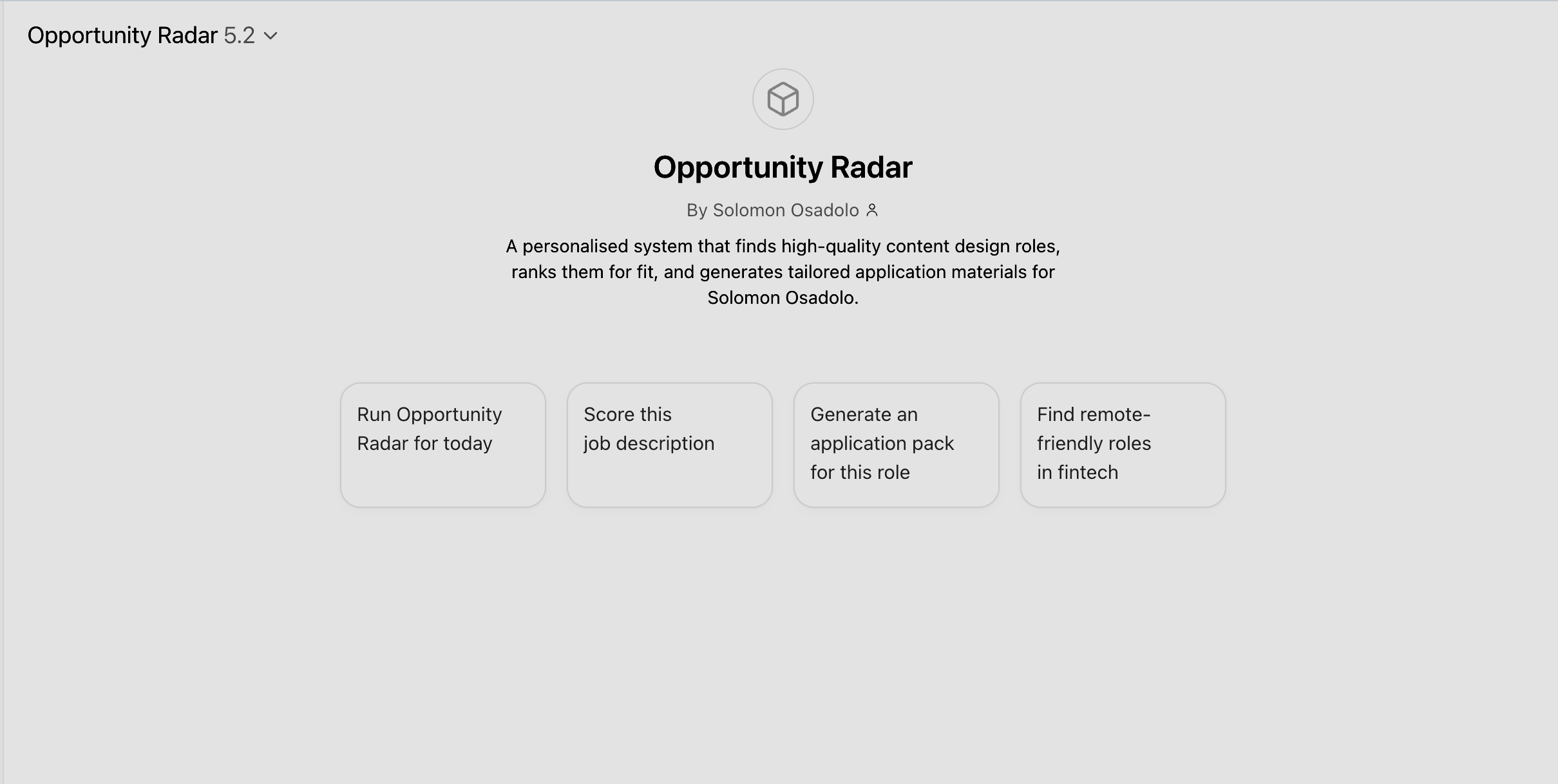
OR home screen.
Motivation: Designing for Clarity (Again)
In my work at OVO Energy, I designed across the Direct Energy funnel and helped drive a 108% uplift in conversion, contributing £6m in additional revenue. At Flutterwave, I built a content design function from scratch and reduced support tickets by over 20% through a redesigned product support website (Help Centre).
Across all my projects, one pattern is clear:
- Reduce friction.
- Improve signal.
- Design for measurable outcomes.
I decided that my job search deserved the same treatment. Thankfully, I'd been doing personal explorations and tinkering with LLMs for quite a while. I wanted to remove the drudgery from finding and applying for the kind of roles I wanted, and it seemed to me that an LLM-powered approach was the natural way to go. I didn’t want another AI toy to parade before anyone who'd care to look. I wanted a decision engine that solved a real problem.
The Core Idea: A Structured Pipeline, Not a Prompt
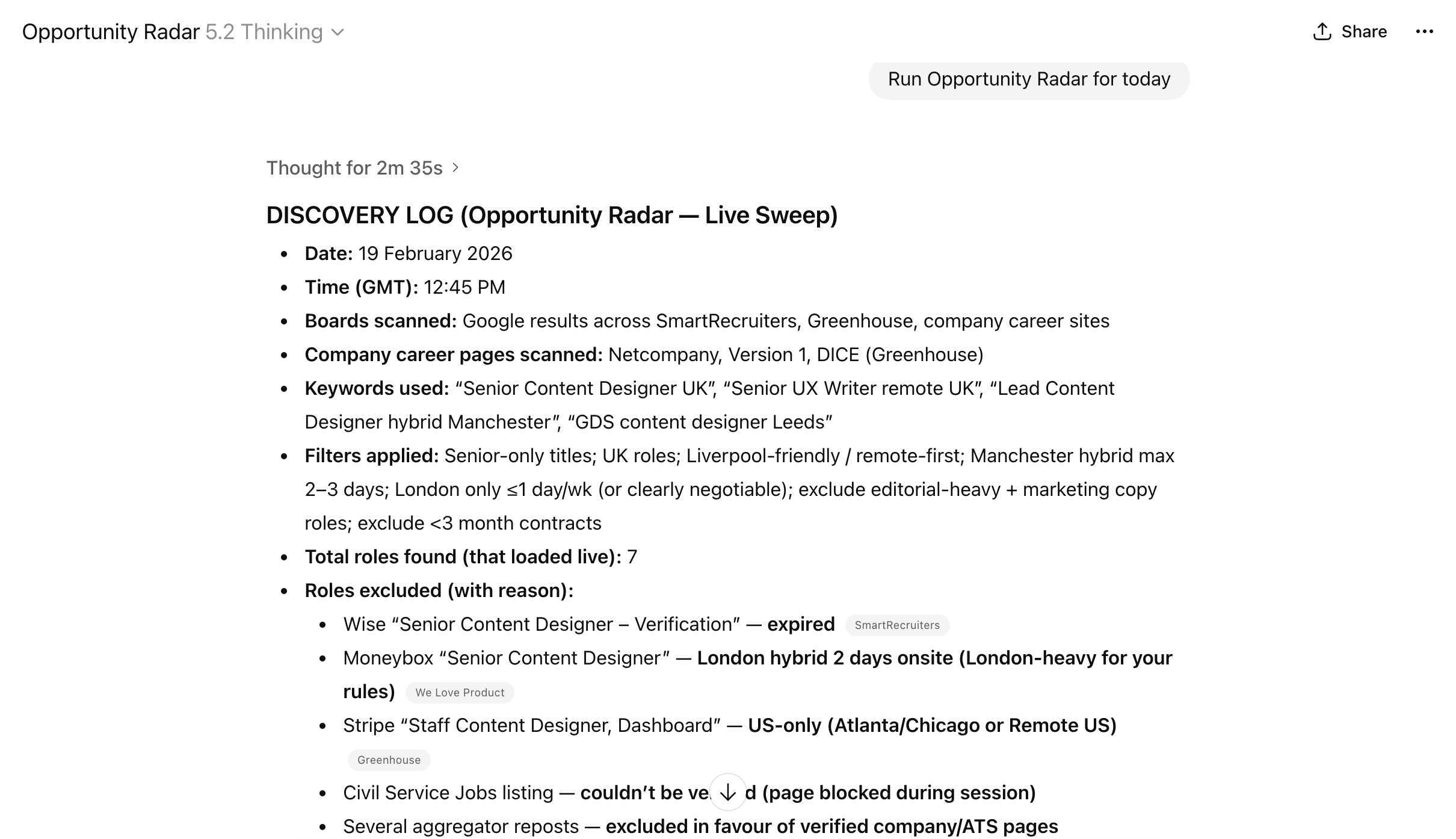
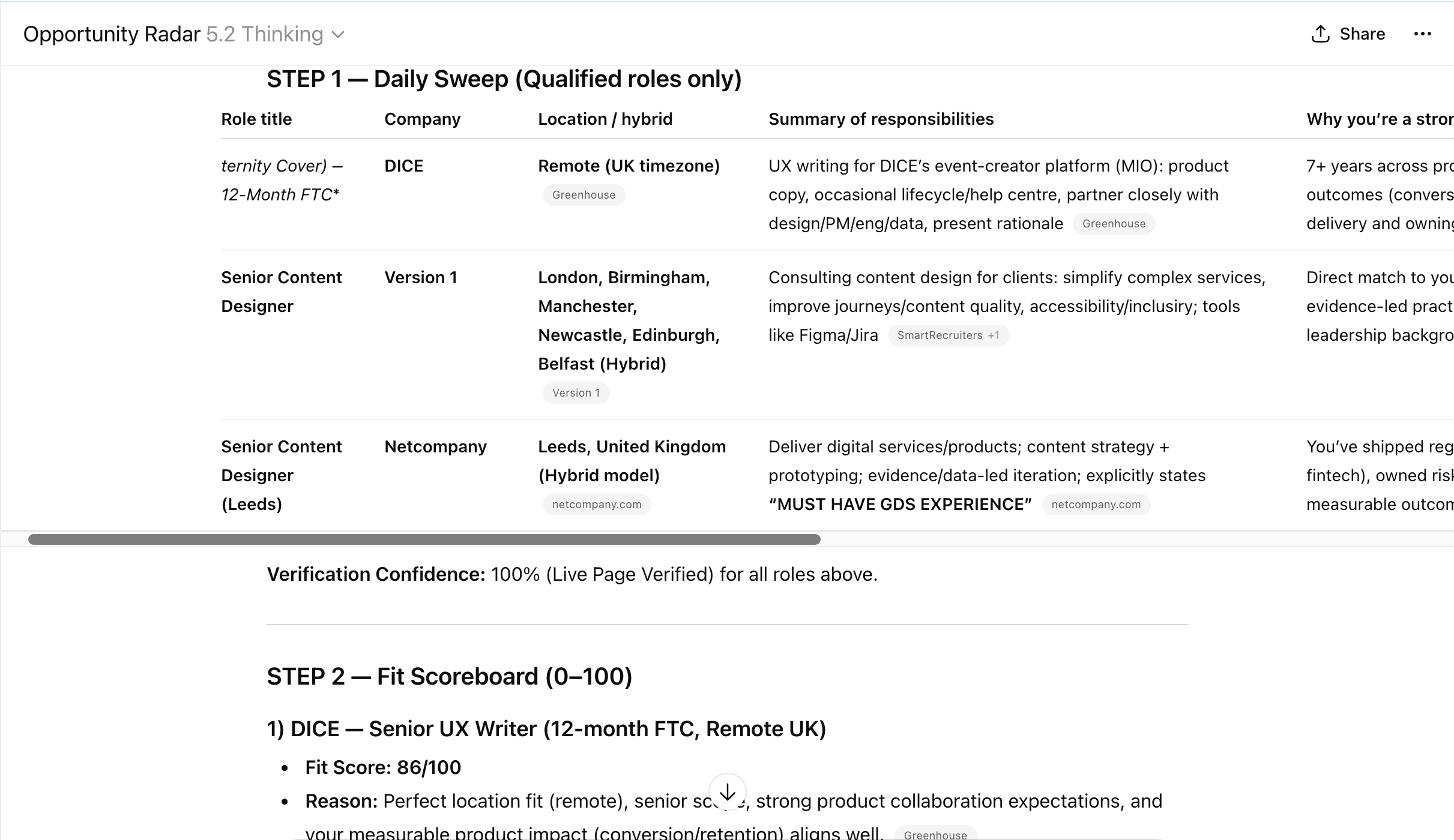
Most people use generative AI reactively: “Write me a cover letter.” That’s useful, but it’s tactical. I built Opportunity Radar to be structural and strategic in its operation. It runs a three-step pipeline:
1. Daily Sweep (Discovery)
It scans the internet for roles aligned to my actual constraints:
- Senior+ Content Design / UX Writing
- Remote-first or Liverpool-friendly (in terms of commuting schedule)
- Fintech, SaaS, Energy, Gov/GDS
- Excludes editorial-heavy or mid-level roles
This is also a function of speed. Before most jobs appear on LinkedIn or Indeed, they may already have been live on the actual company’s career page for days. In today’s job market, recruiter fatigue is a thing, and how early you apply for a role can be the difference between getting an intro email or an automatic rejection.
2. Fit Scoreboard (Prioritisation)
Each role is scored out of 100 based on weighted criteria I selected to help me focus my attention on roles that would potentially be a fit for me:
- Seniority alignment (25%)
- Sector alignment (15%)
- Hybrid feasibility (20%)
- Responsibilities match (20%)
- Growth potential (10%)
- Cultural alignment (10%)
3. Application Production Line (Tailoring)
Only roles scoring ≥ 70 get a full kit:
- Targeted application statement
- Recruiter email
- LinkedIn outreach
- Portfolio mapping
- CV snippet insertion
In other words, the model doesn’t just write. It filters. That constraint is the value. It already has access to my CV, portfolio, and other digital footprint, tracing some of my other professional experiences that may not be captured in my CV. It leans on its knowledge base about me to create application kits tailored to each role that its recommendation engine scores over 70/100 from the search list. All I have to do next is review and, if I wanted to go ahead, deploy.
Principles That Guided the Build
1. AI as a Thinking Partner, Not a Replacement
Opportunity Radar doesn’t decide for me. It externalises my reasoning. The scoring system forces me to articulate what “good” looks like. It’s closer to a rubric than a robot. The final decision, as always, lies with me.
2. Make Bias Explicit
There’s an emotional element to evaluating job posts that tends to skew our ability to assess the opportunity with rigour. “This looks cool,” “I’ve heard of them,” “The brand is strong,” etc.
The weighted scorecard surfaces trade-offs. A London-based fintech role might score high on sector alignment but low on hybrid feasibility if they operate a 3-day-a-week in the office policy — beyond the 1 day (and rarely 2) that’s usually workable. Seeing that tension quantified prevents irrational enthusiasm.
3. Optimise for Energy, Not Volume
I don’t want to apply to 40 jobs. I want to apply to 6 well. The system reduces cognitive load. Instead of doom-scrolling, I review a structured shortlist with clear reasons for or against. That protects creative energy for interviews.
Guardrails: Where AI Stops
If you’re going to integrate AI into career decisions, you need boundaries. Here are mine:
- No fabrication. Every claim must map to my real experience.
- No generic language. If it could belong to anyone, it gets cut.
- No bypassing reflection. I review every output.
- No over-automation of outreach. Personalisation still matters.
The AI drafts. I edit. It’s the same way I treat junior copy or first-pass design artefacts.
Tangible Outcomes
The biggest surprise? Interview readiness improved dramatically.
1. Faster Story Retrieval
Because the system maps portfolio case studies to each role, I walk into interviews already knowing:
- Which metrics matter.
- Which stakeholders to highlight.
- Which trade-offs to emphasise.
For a growth-heavy role, it foregrounds my OVO conversion work. For a platform or fintech role, it prioritises roles & permissions design and billing comprehension clarity work at Flutterwave and HubSpot. That mental priming matters.
2. Sharper Positioning
When generating application statements, the model consistently anchors on:
- Clarity and usability outcomes
- Fintech + energy depth
- Growth experimentation
- Multi-market experience (Africa → US → UK)
- Collaboration with engineering and product
Seeing those themes repeated helped me recognise my own narrative more clearly. Sometimes we need AI to show us our throughline.
3. Better Negotiation Confidence
The Fit Scoreboard exposes leverage. If a role scores 88 because it aligns strongly on sector, scope, and hybrid feasibility, I know I’m not just “interested” — I’m strategically aligned. That clarity changes how you show up in conversations about scope and seniority.
What This Project Means
Opportunity Radar isn’t about being “AI-forward.” It’s about being systematic.
As content designers, we define problems, create frameworks, test constraints, and design for outcomes. Why wouldn’t we apply that to our own careers?
This project demonstrates a few things about how I work:
- I design decision systems, not just interfaces.
- I care about measurable impact.
- I build with guardrails.
- I treat AI as an augmentative tool, not magic.
In many ways, Opportunity Radar is simply an extension of the work I’ve always done — making complexity legible and building structures that enable better decisions. The difference is that this time, the user is me.
And like any good product, it started with a clear problem, strong constraints, and a definition of success. Success, for me, isn’t “any job.” It’s the right senior role, in the right environment, where clarity moves metrics and content design has real influence. Opportunity Radar just helps me find it faster — and with far less noise.